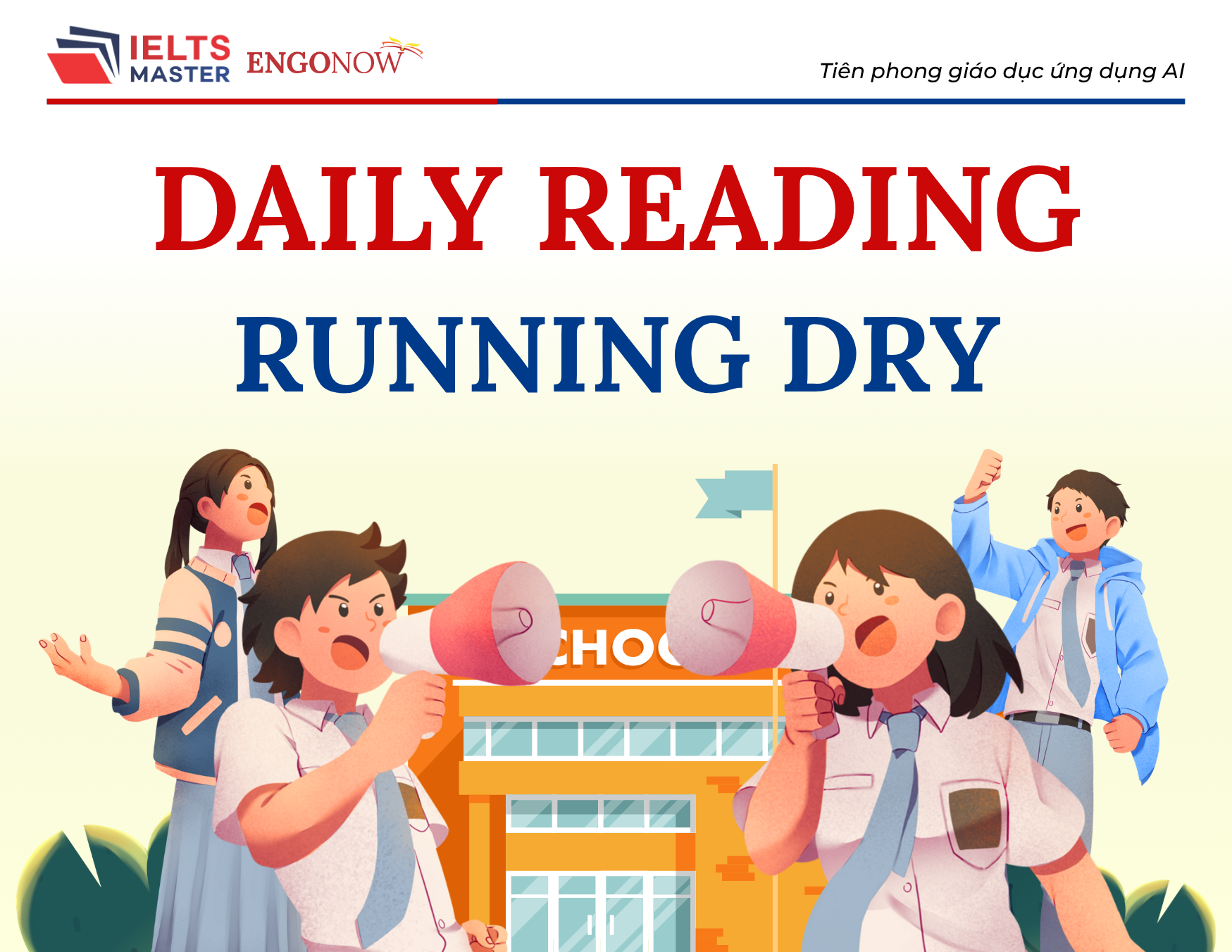
Tại sao việc đọc tiếng Anh mỗi ngày lại quan trọng hơn việc học dồn dập vào cuối tuần? Câu trả lời nằm ở việc luyện đọc thường xuyên. Một thói quen nhỏ được duy trì đều đặn sẽ tạo nên thói quen rèn luyện kỹ năng Reading mỗi ngày. Trong số Daily Reading #12 lần này, chúng ta sẽ cùng thầy đọc qua chủ đề “Running Dry” – một vấn đề nhức nhối mang tính toàn cầu nhưng lại là mỏ vàng từ vựng học thuật dành cho các sĩ tử IELTS và những người yêu thích tiếng Anh.
engonow.com
Bài đọc:
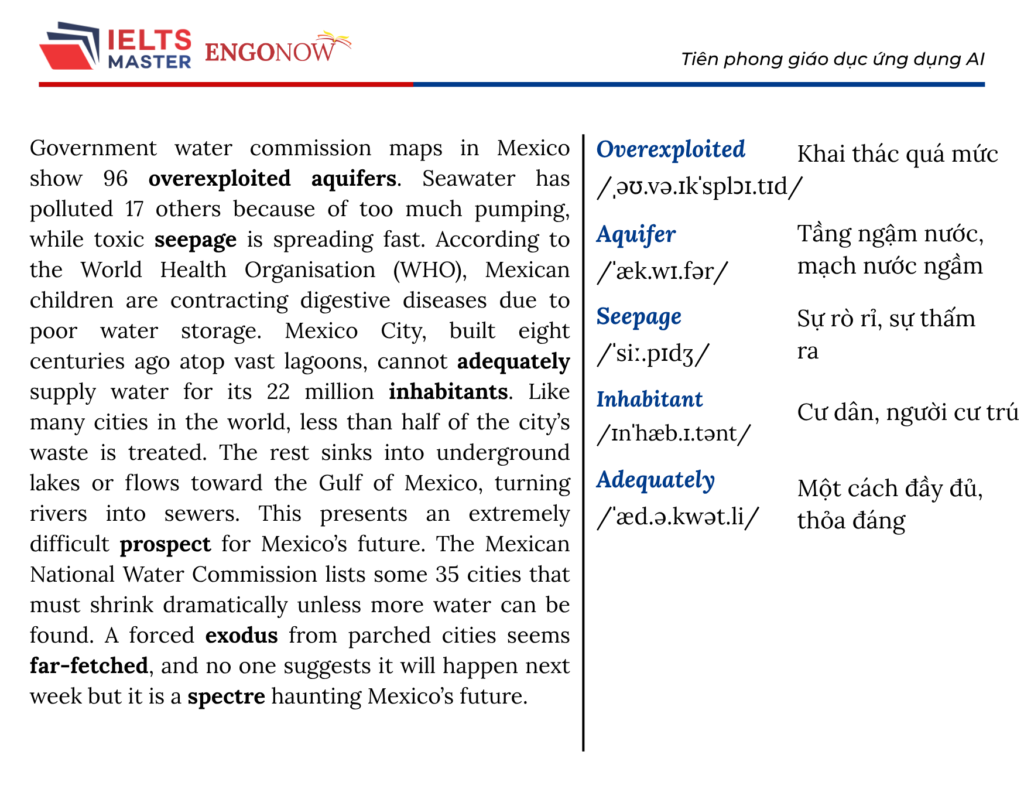
Government water commission maps in Mexico show 96 overexploited aquifers. Seawater has polluted 17 others because of too much pumping, while toxic seepage is spreading fast. According to the World Health Organisation (WHO), Mexican children are contracting digestive diseases due to poor water storage. Mexico City, built eight centuries ago atop vast lagoons, cannot adequately supply water for its 22 million inhabitants. Like many cities in the world, less than half of the city’s waste is treated. The rest sinks into underground lakes or flows toward the Gulf of Mexico, turning rivers into sewers. This presents an extremely difficult prospect for Mexico’s future. The Mexican National Water Commission lists some 35 cities that must shrink dramatically unless more water can be found. A forced exodus from parched cities seems far-fetched, and no one suggests it will happen next week but it is a spectre haunting Mexico’s future.
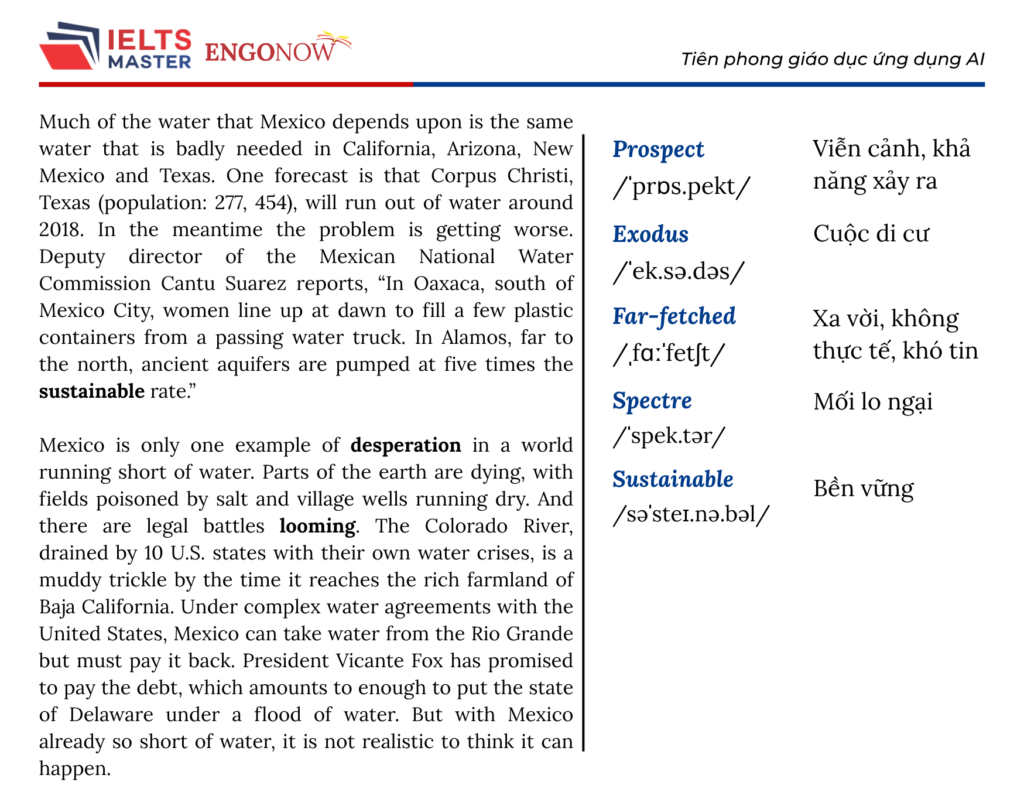
Much of the water that Mexico depends upon is the same water that is badly needed in California, Arizona, New Mexico and Texas. One forecast is that Corpus Christi, Texas (population: 277, 454), will run out of water around 2018. In the meantime the problem is getting worse. Deputy director of the Mexican National Water Commission Cantu Suarez reports, “In Oaxaca, south of Mexico City, women line up at dawn to fill a few plastic containers from a passing water truck. In Alamos, far to the north, ancient aquifers are pumped at five times the sustainable rate.”
Mexico is only one example of desperation in a world running short of water. Parts of the earth are dying, with fields poisoned by salt and village wells running dry. And there are legal battles looming. The Colorado River, drained by 10 U.S. states with their own water crises, is a muddy trickle by the time it reaches the rich farmland of Baja California. Under complex water agreements with the United States, Mexico can take water from the Rio Grande but must pay it back. President Vicante Fox has promised to pay the debt, which amounts to enough to put the state of Delaware under a flood of water. But with Mexico already so short of water, it is not realistic to think it can happen.
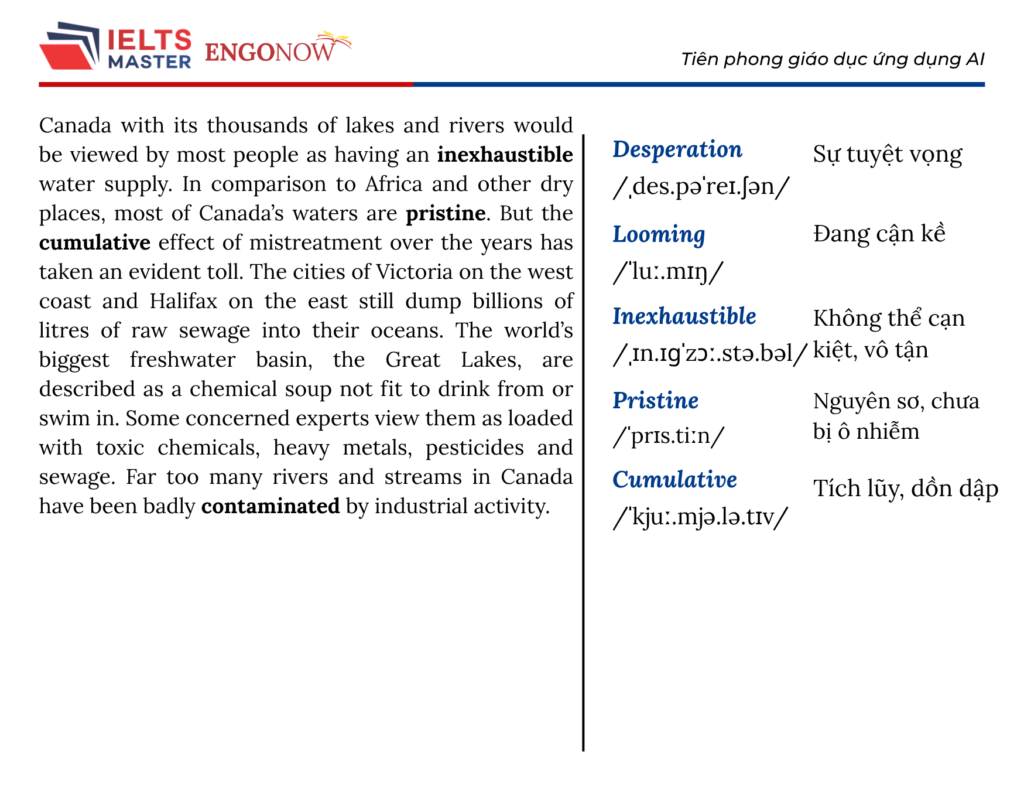
Canada with its thousands of lakes and rivers would be viewed by most people as having an inexhaustible water supply. In comparison to Africa and other dry places, most of Canada’s waters are pristine. But the cumulative effect of mistreatment over the years has taken an evident toll. The cities of Victoria on the west coast and Halifax on the east still dump billions of litres of raw sewage into their oceans. The world’s biggest freshwater basin, the Great Lakes, are described as a chemical soup not fit to drink from or swim in. Some concerned experts view them as loaded with toxic chemicals, heavy metals, pesticides and sewage. Far too many rivers and streams in Canada have been badly contaminated by industrial activity.
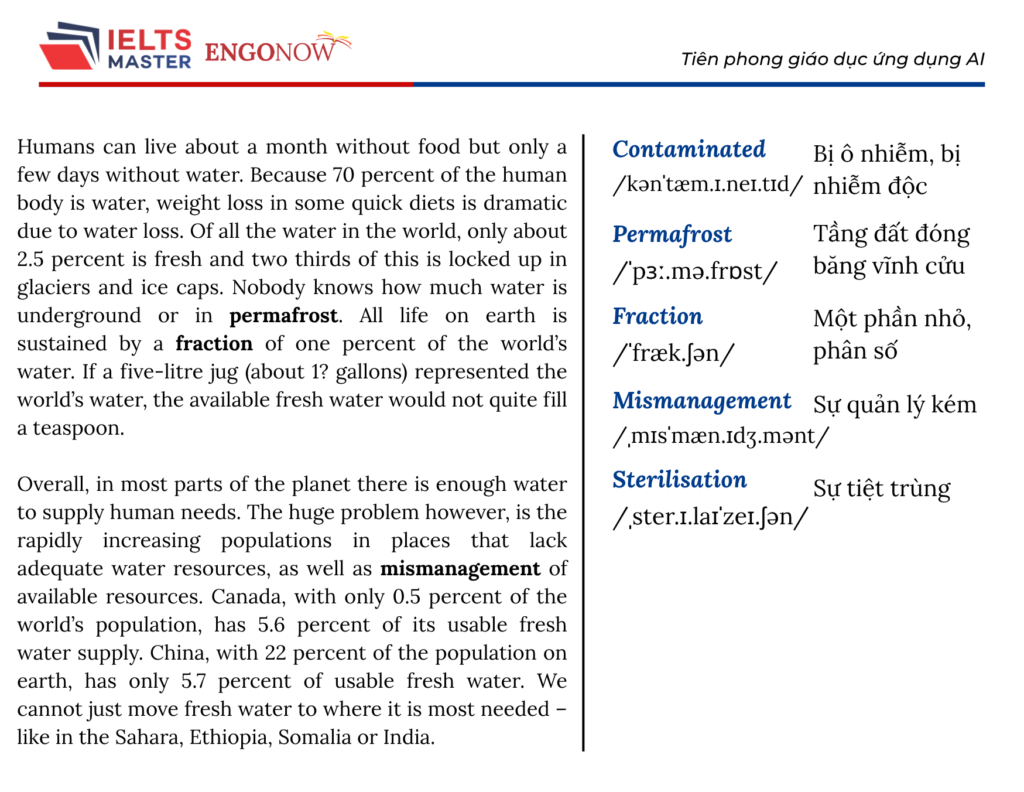
Humans can live about a month without food but only a few days without water. Because 70 percent of the human body is water, weight loss in some quick diets is dramatic due to water loss. Of all the water in the world, only about 2.5 percent is fresh and two thirds of this is locked up in glaciers and ice caps. Nobody knows how much water is underground or in permafrost. All life on earth is sustained by a fraction of one percent of the world’s water. If a five-litre jug (about 1? gallons) represented the world’s water, the available fresh water would not quite fill a teaspoon.
Overall, in most parts of the planet there is enough water to supply human needs. The huge problem however, is the rapidly increasing populations in places that lack adequate water resources, as well as mismanagement of available resources. Canada, with only 0.5 percent of the world’s population, has 5.6 percent of its usable fresh water supply. China, with 22 percent of the population on earth, has only 5.7 percent of usable fresh water. We cannot just move fresh water to where it is most needed – like in the Sahara, Ethiopia, Somalia or India.
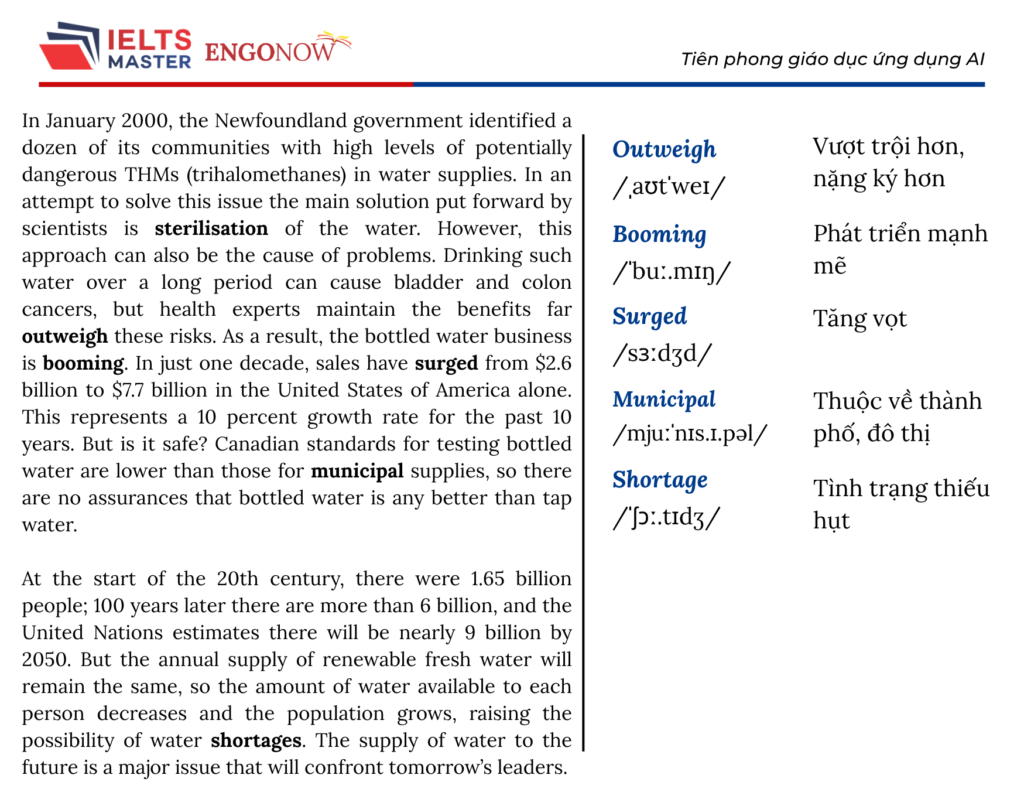
In January 2000, the Newfoundland government identified a dozen of its communities with high levels of potentially dangerous THMs (trihalomethanes) in water supplies. In an attempt to solve this issue the main solution put forward by scientists is sterilisation of the water. However, this approach can also be the cause of problems. Drinking such water over a long period can cause bladder and colon cancers, but health experts maintain the benefits far outweigh these risks. As a result, the bottled water business is booming. In just one decade, sales have surged from $2.6 billion to $7.7 billion in the United States of America alone. This represents a 10 percent growth rate for the past 10 years. But is it safe? Canadian standards for testing bottled water are lower than those for municipal supplies, so there are no assurances that bottled water is any better than tap water.
At the start of the 20th century, there were 1.65 billion people; 100 years later there are more than 6 billion, and the United Nations estimates there will be nearly 9 billion by 2050. But the annual supply of renewable fresh water will remain the same, so the amount of water available to each person decreases and the population grows, raising the possibility of water shortages. The supply of water to the future is a major issue that will confront tomorrow’s leaders.
Từ vựng nổi bật:
- Overexploited /ˌəʊ.və.ɪkˈsplɔɪ.tɪd/: Khai thác quá mức
- Aquifer /ˈæk.wɪ.fər/: Tầng ngậm nước, mạch nước ngầm
- Seepage /ˈsiː.pɪdʒ/: Sự rò rỉ, sự thấm ra
- Inhabitant /ɪnˈhæb.ɪ.tənt/: Cư dân, người cư trú
- Adequately /ˈæd.ə.kwət.li/: Một cách đầy đủ, thỏa đáng
- Prospect /ˈprɒs.pekt/: Viễn cảnh, khả năng xảy ra
- Exodus /ˈek.sə.dəs/: Cuộc di cư
- Far-fetched /ˌfɑːˈfetʃt/: Xa vời, không thực tế, khó tin
- Spectre /ˈspek.tər/: Mối lo ngại
- Sustainable /səˈsteɪ.nə.bəl/: Bền vững
- Desperation /ˌdes.pəˈreɪ.ʃən/: Sự tuyệt vọng
- Looming /ˈluː.mɪŋ/: Đang cận kề
- Inexhaustible /ˌɪn.ɪɡˈzɔː.stə.bəl/: Không thể cạn kiệt, vô tận
- Pristine /ˈprɪs.tiːn/: Nguyên sơ, chưa bị ô nhiễm
- Cumulative /ˈkjuː.mjə.lə.tɪv/: Tích lũy, dồn dập
- Contaminated /kənˈtæm.ɪ.neɪ.tɪd/: Bị ô nhiễm, bị nhiễm độc
- Permafrost /ˈpɜː.mə.frɒst/: Tầng đất đóng băng vĩnh cửu
- Fraction /ˈfræk.ʃən/: Một phần nhỏ, phân số
- Mismanagement /ˌmɪsˈmæn.ɪdʒ.mənt/: Sự quản lý kém
- Sterilisation /ˌster.ɪ.laɪˈzeɪ.ʃən/: Sự tiệt trùng
- Outweigh /ˌaʊtˈweɪ/: Vượt trội hơn, nặng ký hơn
- Booming /ˈbuː.mɪŋ/: Phát triển mạnh mẽ
- Surged /sɜːdʒd/: Tăng vọt
- Municipal /mjuːˈnɪs.ɪ.pəl/: Thuộc về thành phố, đô thị
- Shortage /ˈʃɔː.tɪdʒ/: Tình trạng thiếu hụt
IELTS Master powered by Engonow
Enlighten Your Goal Now.
Quận 6 – Bình Tân, TP HCM / Online toàn cầu.
engonow.edu.vn
Xem thêm: [DAILY READING #8]: DEPRESSION